Oral appliance therapy · Wichita, KS
Oral appliance therapy: the CPAP alternative you wear like a mouthguard
A custom oral appliance holds your lower jaw slightly forward while you sleep, which keeps your airway open. No mask, no hose, no machine. Here’s exactly how Dr. Sheri Love fits one, from the first scan to the one-year check.
How it works
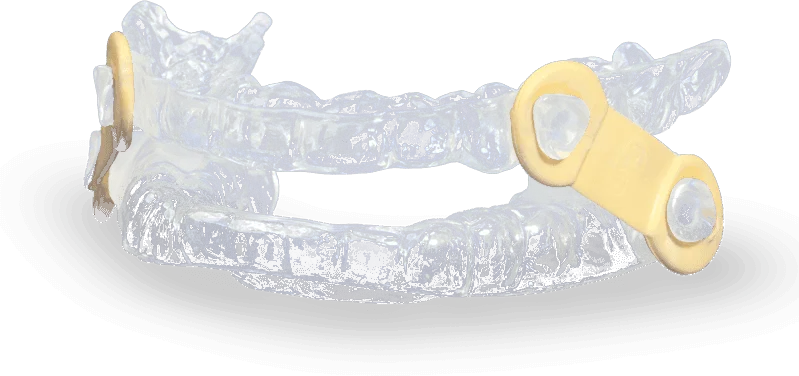
When you fall asleep, your jaw relaxes and your tongue slides back toward your throat. The airway narrows and vibrates, which is the snore. In sleep apnea it closes completely. The appliance holds your lower jaw a few millimeters forward, so the tongue comes with it and the airway stays open all night.
It’s non-invasive, quiet and small enough for a pocket. Because people find it easier to wear every night, it can match CPAP’s real-world results for many patients with mild to moderate sleep apnea, even though CPAP is the stronger treatment on paper.
The Love Sleep process
Treatment starts with a sleep study and a physician’s prescription. Already have them? Fax them to 316-440-4426 or bring them to your visit. If not, we can order a home sleep test.
- ConsultationDr. Love talks with you about your sleep habits, your history and your options. If an appliance is a good fit, you’ll come back for a CBCT scan and a comprehensive exam.
- CBCT scanA 3D image of your head, jaw and airway. If you’ve had one elsewhere, bring it on a disc.
- Digital scanA digital scan of your teeth replaces putty impressions.
- Lab fabricationYour scans go to a specialized dental lab, which makes the appliance and ships it to our office.
- Delivery and fittingWe fit the appliance and make sure it’s comfortable for nightly wear.
- Follow-up careAdjustment visits at about one month, six months and one year. Replacement straps are free during the first year.
The appliances Dr. Love uses
For patients diagnosed with sleep apnea, Dr. Love recommends milled appliances, which are cut from a solid block for a precise, durable fit. They include:
- The EMA (Elastic Mandibular Advancement). Upper and lower trays connected by small elastic straps. Swapping straps changes how far forward your jaw sits, so the fit can be tuned precisely.
- The ProSomnus MicrO2 Sleep and Snore device. A slim, precision-made appliance designed for comfort.
She also offers other designs when a different fit suits your bite, your jaw joint or your comfort better.
Caring for your appliance
- Wear it every night. It only works while it’s in.
- Clean it every morning. Brush and rinse it, and let it dry. The team will show you how.
- Store it in its case. You’ll get a protective case for home and travel. Keep it away from pets, who love to chew them.
What to expect
Most people adjust within a few nights. Early on you may notice some morning jaw or tooth tenderness, extra saliva or a dry mouth; these usually settle quickly. Over the long term, an appliance can gradually shift your bite, which is one reason Dr. Love sees you for regular follow-ups.
The research behind it
- Ramar K, et al. Clinical practice guideline for the treatment of obstructive sleep apnea and snoring with oral appliance therapy. Journal of Clinical Sleep Medicine, 2015. (American Academy of Sleep Medicine and American Academy of Dental Sleep Medicine.)
- Sutherland K, Phillips CL, Cistulli PA. Efficacy versus effectiveness in the treatment of obstructive sleep apnea: CPAP and oral appliances. Journal of Dental Sleep Medicine, 2015.
- Scherr SC, et al. Definition of an effective oral appliance for the treatment of obstructive sleep apnea and snoring. AADSM consensus report, Journal of Dental Sleep Medicine, 2014.
- Van Haesendonck G, et al. Cardiovascular benefits of oral appliance therapy in obstructive sleep apnea: a systematic review. Journal of Dental Sleep Medicine, 2015.
Questions
Oral appliance questions
Something else on your mind? Call the office at 316-440-9700.
How long does it take to get my appliance?
After your exam and digital scan, the appliance is made by a specialized dental lab and usually takes a couple of weeks. Then come a few short visits to fine-tune it.
Is oral appliance therapy covered by insurance?
For diagnosed sleep apnea it is usually billed to medical insurance, not dental. Love Sleep is out of network with medical plans, verifies your benefits, handles pre-authorization when needed and submits the claims.
Is it uncomfortable?
Most patients adjust within a few nights. Some feel mild jaw or tooth tenderness in the morning at first, which usually fades within minutes of taking the appliance out.
What does EMA stand for?
Elastic Mandibular Advancement. The EMA uses small elastic straps to set how far forward your lower jaw sits, so Dr. Love can adjust it precisely.
How do I clean it?
Brush and rinse it every morning, let it dry, and keep it in its case. The team will show you exactly how and how often.
Related
Keep reading
Ready to sleep through the night?
Call the office or request a consultation online. If you haven’t had a sleep study yet, we can order a home sleep test for you.